Advanced Wonderlic Strategies: Score Mastery Guide
You have likely taken a practice Wonderlic test before. Perhaps you received a decent score, but you know you can do better. In a competitive job market, "decent" is often not enough to secure a top-tier position. How do you move from an average score to the 90th percentile? This guide targets ambitious test-takers determined to outperform the competition and impress employers.
To reach the top, you need more than general knowledge. You require a specific mental framework and advanced strategies. This comprehensive guide reveals the cognitive techniques used by top performers. Whether you are applying for a tech role or a nursing program, these proven methods will transform your results. The first step is to start your test to establish your current baseline.
At WonderlicTest.net, we provide highly realistic simulation tools. Our platform helps you understand the structure, timing, and pressure of the actual exam. By the end of this article, you'll have a clear roadmap for significant score improvement. This will help you approach the Wonderlic test with confidence and strategic insight. Let’s dive into the advanced strategies that lead to true mastery.

Understanding the Advanced Scoring Framework
To improve your score, you must first understand how the scoring system actually works. The Wonderlic Personnel Test (WPT) uses a 50-question format. You have exactly 12 minutes to complete it. This means you have about 14 seconds per question. Most people fail not because the questions are too hard, but because the clock is too fast.
Beyond Raw Score: The Percentile Performance Benchmark
Most test-takers focus only on their raw score, which is the number of correct answers. However, recruiters look at percentiles. An "exceptional" score depends heavily on your industry. For example, a score of 21 is the national average, but a score of 30 or higher is often required for systems analysts or chemists.
To improve wonderlic score significantly, you must aim for the benchmarks of your target profession. If you are aiming for a leadership role, you generally need to be in the top 10% of test-takers. Understanding these benchmarks helps you set a realistic but ambitious goal. This gives you a clear target during your preparation. You can see your results on our platform to see how you compare to these industry standards.
Question Weighting and Strategic Prioritization
Every question on the Wonderlic is worth exactly one point. A very difficult logic puzzle gives you the same reward as a simple spelling question. High-scoring individuals recognize this and use it to their advantage. They do not get "stuck" on hard questions.
High-scoring wonderlic techniques involve identifying "low-hanging fruit." These are questions you can answer in five seconds or less. By banking these points early, you create a "time cushion" for the more complex math or logic problems later in the test. Never let a single difficult question steal two minutes of your time. This prioritization ensures you maximize your point potential within the strict 12-minute limit.
Advanced Time Management for Maximum Efficiency
Time management is the single most important factor in wonderlic test mastery. Most people only finish about 30 to 35 questions. If you want a top score, you need to see all 50 questions. This requires a shift in how you view the 12-minute limit. You are not just solving problems; you are managing a very limited resource: time.
The 50/50 Rule: Strategic Question Triage
The 50/50 rule is an advanced wonderlic strategy used to maintain momentum. When you look at a question, you have two seconds to decide: "Do I know this immediately?" If the answer is yes, solve it. If the answer is "maybe" or "no," you must make a quick guess and move on.
Triage is about survival. In a medical emergency, doctors treat the most viable patients first. In the Wonderlic, you "treat" the easiest questions first. If you spend 60 seconds on one math problem, you have effectively lost the chance to answer four easy vocabulary questions later. Use a free sample test to practice this triage mindset before your actual exam. Developing this instinct is the difference between a good score and a great one.

Mental Endurance Techniques for the Final Minutes
Cognitive fatigue is real. By minute ten, your brain might feel sluggish. This is where most scores take a dip. To achieve exceptional wonderlic performance, you must train your mental endurance. This involves "sprinting" through the final two minutes.
One effective technique is "rhythmic breathing." Taking short, controlled breaths can keep your heart rate steady even when the timer turns red. Another tip is to skip all long word problems in the final 90 seconds. Focus instead on quick logic or comparison questions. This ensures you are still earning points even when your energy is low. Consistent practice helps your brain maintain a high processing speed from the first second to the last.
Cognitive Psychology Approaches to Problem Solving
The Wonderlic measures "fluid intelligence." This is your ability to solve new problems without relying on previous knowledge. By applying basic cognitive psychology, you can actually improve how your brain processes these tasks. Mastering these internal processes is the key to high-scoring wonderlic techniques.
Pattern Recognition for Math and Sequences
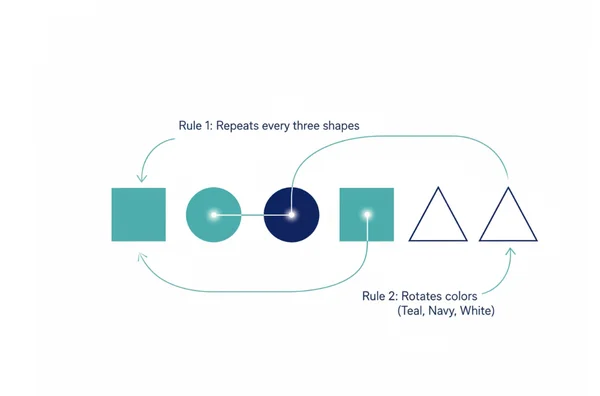
Many Wonderlic math questions are not about calculation; they are about patterns. Instead of doing long division, look for the relationship between the numbers. Is the sequence doubling? Is it adding a prime number? Recognizing the pattern allows you to bypass the manual math.
Advanced test-takers use "estimation" rather than exact calculation. If a question asks for 19% of 500, they calculate 20% of 500 (which is 100) and pick the answer slightly below that. This saves precious seconds. Practicing with our online tool will help you sharpen these pattern-recognition skills. Over time, you will start to see the answers before you even finish reading the question.
Working Memory Enhancement for Complex Problems
Working memory is the "RAM" of your brain. It holds information while you work on a problem. The Wonderlic often tries to "overload" your working memory with wordy questions. To counter this, simplify the question in your mind immediately.
For example, if a logic question involves three people and their heights, don't try to remember the whole story. Use a small scratchpad to write "A > B > C." Turning abstract words into visual symbols reduces the load on your brain. This mental "shortcut" is a hallmark of advanced wonderlic strategies. It allows you to solve complex logic puzzles without feeling overwhelmed. Efficient memory management keeps your cognitive focus sharp for the duration of the exam.
Your Path to Exceptional Wonderlic Performance
Achieving a high score on the Wonderlic is not just about being "smart." It is about being strategic. By understanding the scoring framework, mastering your time management, and using cognitive psychology, you can reach the 90th percentile. Raw talent only gets you so far. Strategic practice is what creates winners.
Put these strategies into action through focused, daily practice that targets your specific weaknesses. At WonderlicTest.net, we offer more than just a timer and some questions. Our platform provides an AI-driven analysis that shows you exactly where your weaknesses lie. This personalized report helps you see which cognitive areas need the most work.
Your career advancement deserves a strategic approach—not just luck. Take the next step in your preparation journey today. Try our free tool to experience a realistic testing environment and start your journey toward score mastery. With the right techniques and the right tools, you can ace your Wonderlic test and open doors to new opportunities.

FAQ Section
How many points can I realistically improve with advanced strategies?
Most users find that they can improve wonderlic score significantly by 5 to 10 points simply by mastering time management. When you add advanced cognitive strategies and pattern recognition, even higher gains are possible. The key is moving from "calculating" to "recognizing" answers. We recommend you start your test now to see where your starting point is.
What's the most common mistake that prevents score breakthroughs?
The most common mistake is "stubbornness." Many high achievers hate leaving a question unanswered. They stay on a difficult logic puzzle for two minutes, thinking they are being diligent. In reality, they are hurting their score. To achieve wonderlic test mastery, you must learn to guess and move on. Every second you spend on a hard question is a second you steal from an easy one.
How long does it typically take to implement these advanced techniques?
Most people see a difference in their approach after just three to five full-length practice sessions. It takes time for the "50/50 Rule" to become a habit. We suggest practicing once a day for a week. After each session, use our AI analysis report to identify which question types are slowing you down. This targeted approach is the fastest way to reach your goal.