Best Intelligence Test: How to Choose the Right Assessment for Your Goal
The best intelligence test is not the same for every person. A job candidate, a curious adult, a student preparing for a timed aptitude screen, and someone comparing free IQ tests are asking different questions. Some need a professionally administered IQ assessment. Some need a low-stakes online practice experience. Others need a cognitive aptitude test that matches an employer's hiring process. If your goal is Wonderlic preparation, an independent Wonderlic-style practice test can help you understand timing, question variety, and basic performance patterns without treating a practice score as an official result.

This guide explains how to choose the best intelligence test for your purpose, what free IQ test results can and cannot tell you, how Mensa-style challenges differ from formal testing, and where Wonderlic practice fits for adults facing a fast cognitive ability assessment.
What Counts as the Best Intelligence Test?
"Best" depends on the job the test has to do. A strong intelligence assessment should measure the ability it claims to measure, use clear scoring rules, compare results against an appropriate norm group, and explain its limits. The more important the decision, the more you should care about administration conditions, validation, and who interprets the results.
For a formal IQ score, the most defensible path is usually a standardized assessment administered or interpreted by a qualified professional. These tests are designed to measure broad cognitive abilities, not just puzzle speed. They also account for age norms, testing conditions, and measurement error. That kind of result may matter for educational planning, clinical questions, gifted program review, or a documented evaluation.
For personal curiosity, a free IQ test with instant results can be useful as a rough snapshot, but it should stay in the "interesting signal" category. A short online quiz may show whether you are comfortable with patterns, number series, verbal analogies, or spatial reasoning. It cannot carry the same weight as a supervised assessment with known norms and controlled conditions.
For hiring preparation, the best intelligence test is often not a classic IQ test at all. Employers commonly use cognitive aptitude tests that focus on learning speed, problem solving, attention to detail, verbal reasoning, numerical reasoning, and decision-making under time pressure. That is why Wonderlic-style practice can be more relevant than a general online IQ quiz when your real goal is a pre-employment assessment.
Match the Test Type to Your Goal
The easiest way to avoid a misleading result is to name your purpose before choosing a test. A "real IQ test," a Mensa IQ test, a 123test IQ demo, an emotional intelligence test, and a Wonderlic practice assessment are not interchangeable.

If you want an official or high-stakes IQ result, look for standardized administration, clear norms, and qualified interpretation. If you want to explore high-IQ society eligibility, review the society's own admission rules rather than assuming an online challenge qualifies. Many public Mensa-style challenges are practice or entertainment experiences, not membership admission tests.
If you want a quick learning experience, a free IQ test can help you see common item types. Sites such as 123test often present short demos, instant feedback, and a mix of culture-fair or classical question styles.
If you want workplace readiness, choose a practice format that resembles the assessment you expect. Wonderlic-style tests reward fast switching across verbal, numerical, logic, and general problem-solving items.
If you want to understand interpersonal skills, the best emotional intelligence test is a different category. Emotional intelligence tools usually ask about self-awareness, empathy, regulation, and social decision-making. They can support reflection, but they do not measure IQ in the traditional cognitive sense. The same is true for multiple intelligence tests or intelligence type tests: they may help people talk about strengths, but they should not be treated as precise IQ measurements.
How to Judge a Free IQ Test With Instant Results
A best free IQ test should be transparent about what it is. Look for plain language about length, question types, scoring, and limits. A good free test does not need to pretend it is a full professional evaluation. In fact, the more dramatic the promise, the more carefully you should read the fine print.
Start with the format. Does the test explain whether it measures verbal reasoning, abstract reasoning, numerical reasoning, spatial reasoning, or a blend? A short test with ten questions can be fun, but it cannot sample the same range of ability as a longer standardized battery. If the test gives a single number, it should make clear that the score is an estimate.
Next, look at scoring context. Does it compare you with a norm group, or does it simply count correct answers? Does it give a range rather than a sharp number? IQ scores are commonly centered around an average of 100, and many modern scales use a standard deviation of 15. That means small differences between online scores are not worth over-reading, especially if the test is short or taken under casual conditions.
Also watch for identity-based or fear-based language. A responsible test should not label you as smart, dumb, broken, superior, or hopeless. It should describe performance, explain uncertainty, and encourage reasonable next steps. If a test uses a celebrity IQ claim, a fake university name, or a "Harvard IQ test free" angle without a clear official source, treat it as a marketing hook rather than evidence of quality.
Finally, notice what happens after the result. Some tests provide educational explanations, sample answers, or next-step guidance. Others push hard toward a paid certificate without giving enough context. A useful online result should leave you better informed, not pressured.
Where Wonderlic Practice Fits for Adults
Wonderlic preparation belongs in the cognitive aptitude category. The classic Wonderlic format is known for its fast pace, mixed question types, and heavy time pressure. That makes it different from a relaxed online IQ quiz, even when both involve reasoning.
For adults preparing for hiring or school-related screening, the practical question is not "What is my permanent intelligence level?" It is "Can I handle this format, manage time, recognize question types, and improve my strategy?" An independent Wonderlic preparation resource is useful because it lets you practice the experience rather than only read about the concept.
When using Wonderlic-style practice, focus on patterns you can act on. Did you spend too long on difficult math? Did verbal analogy questions slow you down? Did you guess too early, or did you leave too many items unseen? A basic practice score is less valuable than the habit of reviewing timing, accuracy, and decision rules.
It also helps to keep the boundary clear. A practice test is not the official Wonderlic, and an AI Personalized Report should be treated as educational feedback for self-reflection and preparation. It can point to strengths, challenges, and possible study actions, but it should not be used as a formal psychological evaluation or employment decision.
A Simple Selection Checklist
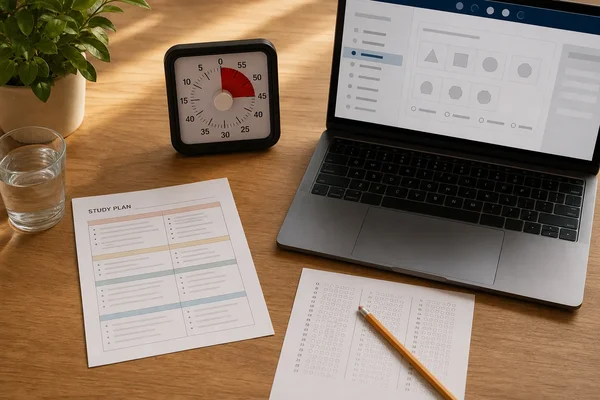
Use this checklist when comparing the best online intelligence test options:
-
Define the decision. Is this for curiosity, school planning, Mensa eligibility research, job assessment preparation, or personal reflection?
-
Match the construct. Use IQ tests for cognitive ability, aptitude tests for workplace readiness, emotional intelligence tests for interpersonal reflection, and Wonderlic practice for Wonderlic-style timing and mixed reasoning.
-
Check administration. High-stakes results need controlled conditions and qualified interpretation. Casual online results are better for orientation and practice.
-
Review the question mix. A stronger test explains whether it uses verbal, numerical, spatial, logical, or abstract items.
-
Read the scoring language. Prefer score ranges, explanations, and limitations over absolute-sounding labels.
-
Watch the time limit. If your real assessment is timed, practice under time pressure. If your goal is broad ability measurement, speed alone should not dominate the experience.
-
Avoid over-personalizing one result. Sleep, stress, language familiarity, device distractions, and repeated exposure can all affect performance.
-
Choose feedback you can use. The best way to test intelligence for preparation is to pair a result with review: what you missed, how long you spent, and what you will practice next.
Choose a Test That Matches Your Next Step
The best intelligence test is the one that fits the question you are actually asking. If you need an official IQ score, look for a professionally administered option. If you are curious, a free IQ test with instant results can introduce the topic, as long as you treat the score as approximate. If you are comparing Mensa IQ test options, separate public practice challenges from supervised admission routes. If you are preparing for a hiring assessment, choose a format that reflects the pace and question mix you will face.

For Wonderlic preparation specifically, make the next step practical: review the format, try timed mixed-question practice, and reflect on what your results suggest about pacing. A structured Wonderlic prep path can support that process without presenting practice feedback as an official score. Used that way, testing becomes less about chasing a label and more about building a clearer plan.
FAQ
What is the most accurate intelligence test?
The most accurate option depends on the purpose. For a formal IQ score, a standardized test administered or interpreted by a qualified professional is usually the strongest route. For job assessment preparation, the most useful test may be a validated cognitive aptitude practice format that matches the actual assessment. For casual curiosity, online tests can be informative, but their results should be treated as estimates.
Is 72 IQ dumb?
No single number should be used as an insult or identity label. A score around 72 is below the average range on many IQ scales, but interpretation depends on the specific test, conditions, age norms, language background, and broader functioning. If a score raises real concerns about school, work, or daily support needs, it is better to speak with a qualified professional than rely on an online result.
What is Elon Musk's IQ level?
There is no widely verified public IQ score for Elon Musk. Online claims about celebrity IQ scores are often repeated without documentation. It is more useful to evaluate intelligence tests by their design, norms, and interpretation rules than by celebrity comparisons.
Is a 120 IQ considered high?
On many modern IQ scales, 100 is average and 120 is above average. It is not usually the threshold for the very highest ranges, but it does suggest stronger-than-average performance on that particular test. The exact meaning still depends on the test used and the confidence range around the score.
What is the best free IQ test?
The best free IQ test is one that clearly explains its question types, length, scoring method, and limitations. A good free test can be useful for practice or curiosity, especially if it gives instant results and answer explanations. It should not claim to replace a formal evaluation.
Is a Mensa IQ test free?
Some Mensa-related websites offer free online challenges or practice-style experiences. These are useful for orientation, but they usually do not qualify someone for membership. If your goal is admission, check the relevant Mensa organization's supervised testing or accepted evidence rules.
Is there a real IQ test online?
There are serious online tests and useful practice tests, but "real" can mean different things. A professionally supervised assessment carries more weight than a casual quiz. An online test can still be helpful if it is transparent, well designed, and honest about its limits.
What is the best emotional intelligence test?
The best emotional intelligence test is one that matches your goal: workplace reflection, coaching, relationship awareness, or personal development. It should not be confused with an IQ test, because it focuses on emotional awareness and social judgment rather than abstract cognitive reasoning.