How to Beat the Wonderlic the Legit Way With a Study Plan and Practice Strategy
If you searched for how to beat the Wonderlic, you probably want more than a vague reminder to "study harder." The Wonderlic feels different because speed matters as much as knowledge: the classic cognitive format gives you 50 questions in 12 minutes, so even smart test-takers can lose points by moving too slowly. A better goal is not to hunt for secret answers, but to build a repeatable system for recognizing question types, skipping wisely, and keeping your pace steady. For a realistic starting point, you can use a Wonderlic practice environment to feel the time pressure before you design your study plan.

What "Beat the Wonderlic" Really Means
To beat the Wonderlic in a legitimate way, you need to improve the parts of performance that are actually trainable: format familiarity, mental math speed, reading accuracy, pattern recognition, and time control. You are not trying to outsmart the hiring process, memorize leaked answers, or pretend a practice result is an official score.
That distinction matters. Many searches around this topic include phrases such as "Wonderlic answers," "questions and answers PDF," or "coupon code." Those terms point to a real anxiety: people want certainty before a timed assessment that may affect a job, school, or program application. But certainty is not the same thing as preparation. A PDF full of answers may teach you to recognize a few sample items, while a study system teaches you how to respond when the wording changes.
Think of the test as a short performance under constraints. You need enough accuracy to collect points, enough speed to avoid getting trapped, and enough judgment to move on when a question is not worth the time. That is the useful meaning of "beat."
Know the 50-Question, 12-Minute Format Before You Study
The classic Wonderlic cognitive format is famous for its pace: 50 multiple-choice questions in 12 minutes. That gives you about 14 seconds per question on average, which is why many people do not finish every item. Some modern Wonderlic assessments may include additional untimed sections for motivation or personality, and scoring can depend on the role or organization using the assessment. Still, the timed cognitive section is the part most people mean when they talk about beating the Wonderlic test.
This format changes how you should study. A slow, perfect solution is not always the best solution. You need to know when to calculate, when to estimate, when to eliminate impossible answers, and when to leave a question behind. The strongest prep plan includes timed practice, not just untimed review.
Use this simple pacing rule during practice:
- First pass: answer the items you can solve quickly and confidently.
- Second pass: spend limited time on medium questions where one more step may unlock the answer.
- Let-go rule: if you are stuck after a reasonable attempt, mark your best choice if appropriate and move forward.
The point is not to rush blindly. It is to protect your attention for questions where your time can become points.
Build Your Wonderlic Study Guide Around Four Question Families
A good Wonderlic study guide should not treat every question as a separate mystery. Group questions into families so your brain knows what kind of move to make.
Verbal logic and vocabulary
These questions may ask about word meanings, analogies, sentence logic, or relationships between terms. The trap is overthinking. Read the exact wording, decide what relationship is being tested, and eliminate answers that are close but not exact.
Practice move: after each verbal question, write a five-word note about the relationship, such as "part to whole," "opposite meaning," or "cause and result." This trains pattern recognition instead of memorization.
Numerical reasoning
Numerical questions may involve arithmetic, percentages, ratios, averages, or short word problems. Because calculators are often not allowed on the timed cognitive section, your goal is clean estimation and fast setup.
Practice move: drill common conversions, such as fractions to percentages, and learn to round when the answer choices are far apart. If the options are close, slow down just enough to avoid a careless arithmetic error.
Pattern and spatial reasoning
Some items test sequences, shape rotation, grids, or visual logic. These can be quick points when you know what to scan for: direction, number of sides, shading, position, rotation, or alternating rules.
Practice move: describe the rule out loud in one sentence during review. If you cannot explain the rule simply, you probably guessed from appearance rather than logic.
General problem solving
The Wonderlic also includes mixed logic questions that combine reading, common knowledge, and practical reasoning. These questions reward careful reading under pressure. The fastest test-takers often win points by noticing a small condition in the wording.
Practice move: underline the task mentally before solving. Ask, "What am I being asked to find?" before you touch the numbers or answer choices.
If you want to see how these families feel under time pressure, a realistic Wonderlic practice flow can help you connect review notes to timed behavior.

Use Practice Questions Without Memorizing Answers
Wonderlic practice questions are useful when you use them correctly. They are less useful when you treat them as a search for the exact future test. The real value of practice is not the answer key; it is the review process after each attempt.
For every missed or slow question, label the reason:
- Concept gap: you did not know the math, vocabulary, or logic pattern.
- Setup error: you knew the idea but chose the wrong operation.
- Reading error: you missed a word such as "not," "least," "except," or "closest."
- Time trap: you spent too long on a question that should have been skipped.
- Careless mark: you solved correctly but selected the wrong option.
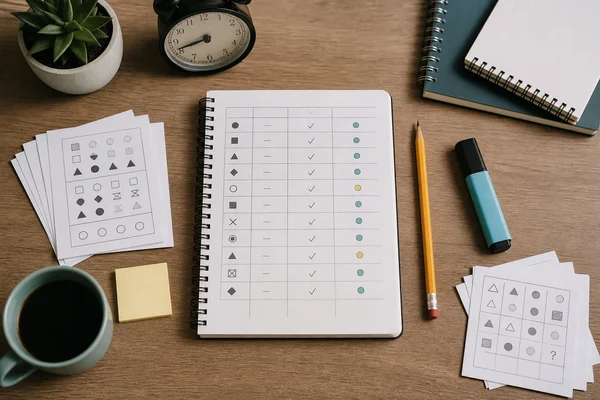
This mistake log turns random practice into a study plan. After 30 to 50 questions, patterns usually appear. Maybe you are accurate on verbal items but slow on ratios. Maybe spatial questions are fine until the shapes rotate. Maybe your score drops only when you refuse to skip.
That is why "Wonderlic test questions and answers PDF" is a limited strategy. A static PDF can be useful for exposure, but it cannot show your pacing habits unless you time yourself and review the reasons behind each miss. Use answer explanations as feedback, not as scripts to memorize.
Turn Scores Into Decisions, Not Panic
People often ask whether a 27 on the Wonderlic is good, how Wonderlic scores compare to IQ, or what score they need to pass. The safest answer is that score meaning depends on the version of the assessment, the organization using it, and the role or program involved.
For the classic 50-question cognitive format, a raw score is often discussed as the number of correct answers out of 50. A 27 is commonly treated as above average in many public score discussions, but it is not a universal pass, and it should not be treated as a direct IQ score. Wonderlic-style tests measure time-limited cognitive problem solving in a specific assessment context. IQ comparisons can be interesting, but they are not the same as a formal intelligence evaluation.
Use practice scores as decision signals:
- If your score is low and you leave many easy questions blank, focus on pacing.
- If your score is low because of repeated math misses, focus on core math patterns.
- If your score is inconsistent, practice shorter timed sets to stabilize your routine.
- If your score is already near your target, focus on reducing careless mistakes.
This is also where a personalized review can help. Instead of asking whether one number is "good," ask what your mistakes say about the next study session.
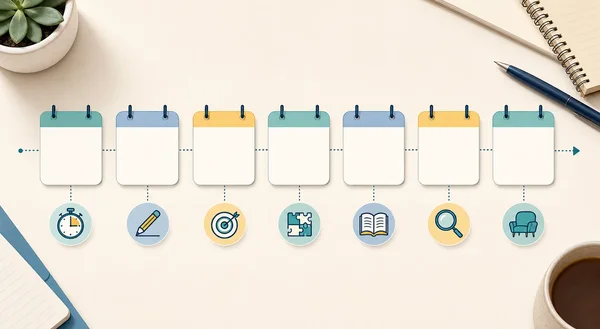
A Seven-Day Plan to Beat the Wonderlic Test Pressure
If your assessment is coming soon, you do not need a complicated study calendar. You need a focused cycle that balances learning, timing, and review.
Day 1: Take a baseline
Complete a timed practice set. Do not pause the timer. Record your score, number attempted, number skipped, and the question types that slowed you down. This is not a judgment; it is your map.
Day 2: Fix your biggest question family
Choose the one category that cost you the most points. Work slowly at first, then finish with a short timed drill. Accuracy comes before speed, but speed must enter the session before you stop.
Day 3: Practice pacing
Do several small timed sets instead of one long session. Your goal is to feel when 15 seconds has passed. Review every question where you spent too long, even if you answered correctly.
Day 4: Train easy points
Review question types you can improve quickly: basic arithmetic, simple word relationships, number sequences, and reading traps. These are the points that often disappear through nerves rather than difficulty.
Day 5: Simulate the full pressure
Take a longer timed practice test or a close equivalent. Sit in a quiet place, use only the materials allowed for your situation, and do not stop when the set feels uncomfortable.
Day 6: Review patterns, not everything
Study your mistake log. Pick three rules you will use on test day, such as "skip after one stall," "estimate before calculating," or "read the final question twice."
Day 7: Light review and reset
Do not overload your brain with new tactics. Review your pacing rule, complete a few warm-up questions, prepare your testing space or logistics, and sleep as well as you can.
The plan is simple because the test is short. You are building a calm routine that can survive a fast clock.
When a Free Practice Test Is Enough and When More Prep Helps
A free Wonderlic practice test can be enough if you only need to understand the format, reduce uncertainty, or check whether the question style feels familiar. Free practice is also useful when your assessment is low stakes or you already have strong speed and accuracy.
More structured prep may help if your baseline shows repeated weak spots, if you freeze under time pressure, or if you have very little time before an important assessment. In that case, look for resources that explain why answers are right, include timed practice, and make their independence clear. Be cautious with any resource that promises a certain score, claims to know your exact test, or sells "real answers" as the main benefit.
Coupon-code searches are not the main issue. A discount can be nice, but the better question is whether the prep method will actually change your behavior under a 12-minute clock. If it only gives you more content without review, it may not solve the problem that is costing you points.
Your Next Step for a Smarter Wonderlic Prep Session
The best way to beat the Wonderlic is to make your next practice session more specific than your last one. Choose one timed set, one pacing rule, and one review question: "What type of mistake cost me the most today?" That gives you a cleaner path than jumping between PDFs, answer lists, and generic advice.
WonderlicTest.net is an independent preparation resource, not the official Wonderlic administrator. Use it as a place to explore the format, practice under pressure, and reflect on your results. When you are ready to turn the ideas in this guide into a practical session, a structured Wonderlic prep session can help you connect speed, accuracy, and review in one place.

FAQ
How do you beat the Wonderlic test?
You beat the Wonderlic by improving your performance under time pressure. Learn the format, practice common question families, use timed sets, review mistakes by cause, and create a skip rule so one hard question does not drain time from several easier ones.
How hard is it to pass the Wonderlic test?
It depends on the assessment version and the organization using it. The timed cognitive section is challenging mainly because of pace: 50 questions in 12 minutes leaves little room for slow problem solving. Many people can improve their practice performance by becoming more familiar with the format and pacing.
Is a 27 on the Wonderlic good?
A 27 is often discussed as an above-average score for the classic 50-point cognitive format, but "good" depends on the role, school, employer, or assessment version. Treat a practice score as feedback for preparation, not as a universal pass-or-fail label.
What is the 50-question test in 12 minutes?
That phrase usually refers to the classic Wonderlic cognitive ability format, where test-takers answer up to 50 multiple-choice questions in 12 minutes. The questions may include verbal reasoning, math, logic, and problem solving.
Are Wonderlic questions and answers PDFs useful?
They can be useful for basic exposure, but they are not enough by themselves. You still need timed practice and answer review. A PDF answer key tells you what was correct; a good review process tells you why you missed points and what to change next time.
Is "Beat the Wonderlic" legit?
If you mean the general idea of beating the Wonderlic, the legitimate path is practice, pacing, and review. If you mean a specific prep product using that phrase, check whether it clearly explains its independence, what materials it includes, whether it offers answer explanations, and whether it avoids unrealistic score promises.
Can Wonderlic scores be converted to IQ?
You may see informal score-to-IQ comparisons online, but they should be treated carefully. A Wonderlic-style score reflects performance on a short, timed assessment. It is not the same as a formal IQ evaluation, and modern hiring assessments may use broader scoring models than a single raw number.