Wonderlic Basic Skills vs. Cognitive Test: Differences & Prep
You’ve been asked to take a “Wonderlic test” as part of a job application or school admission process. But a quick search reveals a confusing reality: there isn't just one type. You might be facing the Wonderlic Basic Skills Test or the more famous Wonderlic Cognitive Ability Test. So, which one will you be taking, and how should you prepare?
Navigating this uncertainty can be stressful, but understanding the key differences is the first step toward building confidence. This guide will break down everything you need to know about these two distinct assessments. We'll explore their purpose, format, and question types, helping you identify which test is on your horizon.

Effective preparation starts with knowing your target. At WonderlicTest.net, we provide the tools you need to succeed. Our platform offers a highly realistic simulation of the Wonderlic Cognitive Ability Test, complete with AI-powered analysis to guide your studies. To see how you measure up, you can start your test preparation on our platform today.
Wonderlic Basic Skills vs. Cognitive Ability Test: Key Differences
While both tests are published by Wonderlic, they measure entirely different things. The Basic Skills Test evaluates what you already know, while the Cognitive Ability Test assesses how quickly you can learn and solve new problems. Understanding this core distinction is crucial for your prep strategy.
What is the Wonderlic Basic Skills Test (WBST) & Who Takes It?
The Wonderlic Basic Skills Test (WBST) is designed to measure fundamental academic skills. It confirms whether a candidate has the essential math and verbal abilities required to perform specific job duties successfully. Think of it as a check on foundational knowledge, not a measure of abstract reasoning.
Who takes the WBST? This test is most common for entry-level positions, vocational training programs, and roles where proficiency in basic arithmetic and literacy is critical.
- Job roles: Administrative assistants, customer service representatives, cashiers, and various trade positions.
- Industries: Retail, healthcare support, manufacturing, and clerical services.
The WBST tells an employer if you have the necessary building blocks to be trained for a particular job.

What is the Wonderlic Cognitive Ability Test (WCA) & Who Takes It?
The Wonderlic Cognitive Ability Test (WCA), also known as the Wonderlic Personnel Test (WPT) or the Wonderlic Scholastic Level Exam (SLE), measures general intelligence. It assesses your ability to learn, adapt, solve problems, and understand instructions. Its primary goal is to predict how quickly and effectively you can be trained for a role.
The WCA is famous for its use in the NFL Combine, but its application is far broader. It's one of the most widely used pre-employment cognitive assessments in the world.
Who takes the WCA? This test is used for a wide range of roles, especially those that involve complex decision-making, require a steep learning curve, or demand strong problem-solving skills.
- Job roles: Managers, sales professionals, engineers, programmers, and candidates for leadership development programs.
- Industries: Technology, finance, consulting, and law enforcement.
Comparing Question Types, Format, and Time Limits
The most practical way to understand the difference is to look at the structure of each test.
| Feature | Wonderlic Basic Skills Test (WBST) | Wonderlic Cognitive Ability Test (WCA) |
|---|---|---|
| Core Purpose | Measures existing knowledge (math & verbal) | Measures problem-solving & learning ability |
| Time Limit | Usually 20 minutes per section (40 total) | 12 minutes for the entire test |
| Number of Questions | 50 verbal and 45 quantitative questions | 50 mixed questions |
| Question Types | Grammar, sentence correction, reading, basic arithmetic, fractions, percentages. | Logic puzzles, number series, vocabulary, spatial reasoning, word problems. |
| Pacing | Slower-paced, focused on accuracy. | Extremely fast-paced, focused on speed and quick thinking. |
| Main Challenge | Remembering fundamental math and grammar rules. | Managing time and solving unfamiliar problems under pressure. |
The WCA’s intense time constraint—just 14.4 seconds per question—is its defining feature and what makes dedicated practice so essential. To experience this unique challenge, try our free online practice test.
Which Wonderlic Test Will You Take? Identifying Your Assessment
Now that you know the differences, how can you figure out which test you’ll be taking? While the best method is to ask your recruiter directly, you can often find clues on your own.
Clues from Job Descriptions and Industry Standards
Review the job description that prompted your application. The language used can provide strong hints about the skills the employer values most.
- Look for WBST clues: Keywords like "detail-oriented," "strong communication skills," "basic math proficiency," or "data entry" suggest the employer is focused on foundational abilities. The role is likely administrative or service-oriented.
- Look for WCA clues: Phrases like "fast-paced environment," "critical thinking," "problem-solving skills," or "ability to learn quickly" point toward the Cognitive Ability Test. These roles often require you to think on your feet and adapt to new information.
Industry standards also play a role. If you're applying for a management trainee program in the tech industry, you can almost certainly expect the WCA. If it's a front-desk position at a clinic, the WBST is more likely.
Why Employers Use Different Wonderlic Formats
Employers choose these tests strategically. Their goal isn't to trick you but to find the best fit for the role and their organization.
- The WBST validates competency. For a role that requires daily calculations and clear written communication, the WBST provides direct evidence that a candidate possesses these non-negotiable skills. It minimizes training time for basic tasks.
- The WCA predicts potential. For complex roles, specific existing knowledge is less important than the ability to acquire new knowledge. The WCA helps employers identify candidates who are highly trainable and likely to excel when faced with new challenges, making them a good long-term investment.
Tailored Wonderlic Test Preparation for Different Formats
Your preparation strategy should be completely different depending on the test you face. A one-size-fits-all approach won't be effective.
Strategies for Acing the Wonderlic Basic Skills Test
Success on the WBST comes from refreshing your memory of fundamental concepts you learned in school.
- Review Basic Math: Go over addition, subtraction, multiplication, division, fractions, decimals, and percentages. Practice working with units of measurement.
- Brush Up on Grammar: Revisit rules for subject-verb agreement, punctuation, capitalization, and sentence structure.
- Practice Reading Comprehension: Focus on reading passages carefully and identifying the main idea, details, and author's intent. Don't rush; accuracy is more important than speed on this test.
Strategies for Excelling on the Wonderlic Cognitive Ability Test
The WCA is a test of strategy as much as it is a test of intelligence. Your biggest opponent is the clock.
- Master Time Management: With only 12 minutes for 50 questions, you cannot afford to get stuck. The golden rule is to answer what you know quickly and move on.
- Learn to Recognize Patterns: Many questions follow common patterns, especially in number series and logic puzzles. Practice helps you spot these patterns faster.
- Don't Be Afraid to Skip: It is better to skip a hard question and answer three easy ones than to spend a full minute on a single problem. Every question is worth the same amount.
- Practice in a Simulated Environment: The single most effective way to prepare is to take a realistic practice test that mimics the exact timing and format of the real thing. This builds mental stamina and hones your pacing strategy.
Maximizing Your Score with Practice Tests and AI Analysis
Simply doing practice questions isn't enough. To truly improve, you need to understand your performance on a deeper level. This is where WonderlicTest.net offers a unique advantage. After taking our free, full-length practice test, you can unlock a personalized AI Analysis Report.
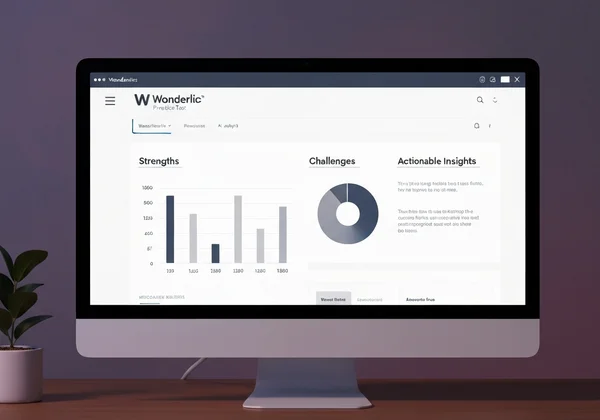
This report goes beyond a simple score. It provides a detailed cognitive profile, highlighting:
- Your Strengths: Which types of questions do you answer quickly and accurately?
- Your Challenges: Where do you lose the most time or make the most mistakes?
- Actionable Insights: Customized advice on which skills to focus on to see the biggest score improvement.
This data-driven approach turns practice from a guessing game into a targeted training plan. You can unlock your AI report after completing your first practice test.
Your Strategic Path to Wonderlic Test Success
To succeed on your Wonderlic assessment, first determine whether you'll be taking the Basic Skills Test or the Cognitive Ability Test. Once you understand what each test measures and how it's structured, you can approach your preparation with confidence rather than uncertainty.
For the WBST, focus on refreshing your foundational knowledge. For the WCA, prioritize speed, strategy, and simulated practice.
Regardless of which test you're taking, thorough preparation will help you approach test day with confidence and perform your best. If the high-stakes Cognitive Ability Test is in your future, there is no better way to prepare than by simulating the real experience. Ready to see where you stand? Take a free practice test on our site and discover your potential.
Disclaimer: WonderlicTest.net is an independent test preparation resource and is not affiliated with, endorsed by, or in any way connected to Wonderlic, Inc.
Common Questions About Wonderlic Basic Skills & Cognitive Tests
How long are the Wonderlic Basic Skills Test and Cognitive Ability Test?
The Wonderlic Cognitive Ability Test (WCA/WPT) is famously short: 12 minutes to answer 50 questions. The Wonderlic Basic Skills Test (WBST) is longer, typically broken into two 20-minute sections, one for verbal skills and one for math skills, for a total of 40 minutes.
What kind of math is on the Wonderlic Basic Skills Test?
The math on the WBST is practical and foundational. It covers basic arithmetic (addition, subtraction, multiplication, division), fractions, decimals, percentages, and simple measurements. It does not include algebra or geometry.
Can you use a calculator on the Wonderlic Test?
No, calculators are not permitted on either the Wonderlic Basic Skills Test or the Cognitive Ability Test. All calculations must be done mentally or with the scratch paper provided, making mental math a critical skill to practice.